Tuesday, November 20, 2007

Richard Eagan's trip back in time

Recently I had the pleasure of gaining the acquaintance of Richard Eagan, a Brooklyn-based artist whose topical work really struck home.

One of the reasons I chose to move to New York City was because of its rich and layered history.

The neighborhoods were a marketing major's wet dream in "branding"-- Little Italy, Chinatown, the Lower East Side, Brighton Beach, and of course, Coney Island.

I remember as a freshman at B.U. how excited I'd get when I'd look across Commonwealth Avenue and see our very own short-lived franchise of weiner prestige, Nathan's Famous.


Now my own knowledge of Coney Island was not very well-versed, but I did have those legendary postcards of pop culture floating in my head-- rickety ferris wheels with cars swinging to and fro; bathing beauties and Vaudevillian sideshows; leopard-leotard burlesque girls with the Betty Page bangs; tatooed muscle men bench-pressing iron with their well-oiled bulging biceps heaving in the salty air.

Fast-forward to 2007. Things are quite different.

Mega-developer Thor Equities' stunning purchase of Astroland Amusement Park has given us an endless drawn-out saga "Was this past season the last hurrah, or will there be one more? Stay tuned."

With all the back and forth, it's as if we're being held hostage by these land-grabbers.

The only survivors-- the Parachute Jump (in some incarnation), and if spared the executioner, the Cyclone.

In the meantime, while the city, local community groups and business owners try to hammer out incorporation of the logistics of all this, Richard Eagan's work is a truly excellent way to reconnect to what once was.

I found it to be a true delight in its sentimental journey back in time.

Eagan has a rich and storied history himself.

A long-time Brooklyn resident himself, in the late 1970s he suddenly found himself having repetitive dreams of Coney Island and his childhood.

For years Eagan had crafted meticulous cabinetry and woodworks in his cabinet shop.

But suddenly things began to take on a new look.

A studio was emerging, as well as an artist.

Eagan delved into creating sculptural-like assemblage pieces which blended elements of the everyday along with the fantastic.

At the same time, along with artist Philomena Marano, in 1981 Eagan formed the Coney Island Hysterical Society-- a collaborative that worked to spotlight the ever-forgotten landscape of yesteryear.

Multiple artist projects were undertaken, including a mural, carousel and an actual haunted house/by-way-of-art-gallery carnival ride, the "Spookhouse. "


Looking at some of Eagan's earlier works, you can almost hear those echoes of "Step right up! Step right up!"

At left is "Fred's House," a piece done in 1982.

In the background is the haunting image of the dearly missed "Thunderbolt", a Coney Island staple for 75 years.

I really found this piece to be quite moving-- the soft-lit crescent moon in the distance.

After all, where else can you go to see the sky so well at night in the 5 boroughs, other than the Coney Island boardwalk?

It leaves me silent-- for I can find no words to express the sadness at never having been able to witness it in its heyday.

After the passing of his wife, Eagan took time away to regroup.

Once again, the boardwalk came calling.

But this time, Eagan also began to express himself with an alter-ego, Kay Sera-- a proper lady, if I ever did meet one, with style and elegance to boot.

She has had an immensely positive influence on Eagan.


Much in the way the chrysallis serves the butterfly, her creation has allowed Eagan to emerge from his cocoon, with wings outspread.

In fact, many of Eagan's pieces involve a starburst-like central creature, exploding from within.

The wooden shards, though they can appear quite dangerous, exist only underneath in a cage-like structure.

In some ways, it is guarded-- a protection mechanism, if you will.

But just who is Eagan protecting: the viewer, or the self?

I also am enthralled by the minute details of the work at right.

In this-- a wooden mock-up of the haunted-house ride previously mentioned-- you can see the tiny wooden planks of a boardwalk.

The saloon doors are perfect in their detail and weather-beaten quality.

The salt-laden air erodes the latex, leaving its mark.

Even the slight spaces between the boards are brilliant in their disalignment.

For Coney Island currently DOES lie in a state of disrepair.

The boardwalk's tens of thousands of wooden planks are deteriorating by the day.

But this fine city is more interested in the amount of funds that it will receive from the monolithic Thor rather than put new wooden planks in for people to enjoy the walk.


Below are images of "Kister's Hotel" and "Open All Year Round."

Again, there is a quiet to these works that I have a hard time describing.

In each, Eagan again reaches out-- windows into another world-- but it is to our detriment that they might not be there for much longer.

For more information on Richard Eagan, go to the link below.

http://www.440gallery.com/

Monday, November 5, 2007

Is there room at the inn for Kara Walker?

This isn't a review of Kara Walker's retrospective at the Whitney, nor her new solo show at Sikkema Jenkins & co.

No.

This is a post where I'm going to bring up something that the art world continually ignores.

No, it's not the "feminist artist" mystique, or whatnot.

And truth be told, if I hear of one more gathering, conference, or "artist talk" put on by priviledged WASPY MFA-educated, gallery repped mid-20s to late 40-something women screaming and complaining of how they're "underrepresented" in the art world, I just may take up arms.

In this case, no, what bothers me MUCH more than any "under-representation" of the female is those of color.

I just got back from a trip to West Virginia, and truth be told, I witnessed more faces of color there than I ever do at a Chelsea gallery opening.

That is UNLESS those of color happen to be like Ms. Walker-- doing work that questions issues of "identity."

Let me say this, if Ms. Walker, perhaps, were doing work more along the lines of the Elizabeth Peytons, Karen Kilimniks, Dana Schutzs or Cecily Browns of the world-- would she have ever gotten to the status where she is now? (I.E., a Whitney retrospective?)

Would Walker have ever been giving the carte-blanche acceptance that Ms. Emin was graced with after "All the men I've ever slept with?"

Highly doubtful.

She would have been crucified.

Because Walker continues to crank out pieces that address what the Caucasian-dominated art glitteratti feels a "black artist" SHOULD be concentrating on, she's been elevated to something not unlike that of a modern minstrel herself, sans tap shoes.

I find it a hell of a lot more disgusting that the few top-publicized artists of color that I can name on my fingers-- Ofilli, Odita, Walker, and Pope L.--are only accepted because their work addresses "being black."

Pardon me while my blood pressure rises just a bit more, but it's not like MFA programs are asking the Schutz's of the world: "Can you have your work address what it's like to be young, white and immediately well-off financially?"

I dare the art world to elevate one artist of color to the forefront whose work might concentrate on color, line, form; political upheaval and protest; optical illusion; or experimental installation.

This is not to say Ms. Walker is not one of the more talented individuals continually making controversial and well-received work; as well as all those artists I've previously named.

I'm thinking of the recent beautifully painted show by artist Julie Heffernan.

I looked at each of her pieces and noted the skill and precision it took to paint those-- as well as the alabaster skin of each of the "self-portraits."

Could a black female artist have been given that type of reception as well?

I have a wish for the art world's eye of the needle to expand just a little beyond the tragic historical past of a people and perhaps more on the triumph of living in the today, as well as opening up the rosters to more of the least expected rather than "Here we go again."

Over and out.

Sunday, November 4, 2007

Ryan McGinness IS an art movement

His button below may directly disagree with my assessment, but in the battle of the similarly named Ryans of "art star" calibre, McGinness beats McGinley hands-down.


Of course the two simply cannot be compared due to their vastly different mediums, lifestyles and genres, but with these works, McGinness has proved to me once again he's worth the hype surrounding him.
Maybe I'm truly going out on a limb here, but I must say he just may be the second coming of Aubrey Beardsley at his recent inauguration of the new Pace Prints space in Chelsea.

See my example of "compare and contrast" below of one of Beardsley's intricate and luxuriously printed Art Nouveau children's book illustration work next to the sinuously flowing eroticism of McGinness' engraved skateboards that strongly utilize the color wheel.


This exhibit just closed at Pace Prints' new Chelsea headquarters truly blew my mind in terms of the artist's use of color play and decorative pattern work.

But truth be told, McGinness' strongest suit yet was his collection of humorous pins.


It brought back to mind my own youthful days as a merch girl for many of Boston's indie rock bands in the early-to-mid-'90s.
It also is a nice nod to being a child of the 1980s.
Certainly the subject matter is a bit mature, but our friendship pins, bracelets and sticker collections were like our generational equivalent to the Summer of Love crowd's medallions.
Here, McGinness deftly combines the two, taking a glance backwards towards the Decorative Arts movement, all the while combining it with psychedelia at its finest, with a final mix of Atari Generation and skater punk thrown in for good measure.
Fun stuff.


Enjoy.

http://www.paceprints.com/exhibitions/exhibitions-H.asp?XS=C

Thursday, October 25, 2007

Dear Nicholas Fraser

Dateline:
Thursday, October 24, 2007
Brooklyn, New York


Dear Mr. Fraser,

Greetings and salutations!

How nice to meet your acquaintance.

Upon Googling myself this evening-- (because this is what one does when one navel-gazes to check on one's blogging successes and failures)-- I found out that I recently did a review on your artwork last month.

Thank you kindly for the memory jog-- sometimes... in fact, many times, the names of who I choose to review slip my mind.

In fact, I just wanted to let you know I truly enjoyed reviewing your work on September 4, 2007, here at the Musings.

I found your work to be provocative, insightful, and well-thought out.

I find it fantastic that you've been able to attain solo shows at John Connelly Presents, Moti Hasson and Yossi Milo Gallery all in 2007 alone.

That is no small undertaking.

But in all seriousness-- dude, seriously, I can't remember who the hell you are, nor can I remember reviewing you.

I do like that your work delves into plageurism and the problem facing current artists today in regards to getting attention for one's work.

**WAVES!!!!***

I certainly like the DIY punk rock nature of you placing yourself into multiple galleries' press releases and saying it's your own.

But silly man, (or woman, whoever you be)... like, seriously, I did this trick back in 2003 when I first moved to NYC, mass-mailing everyone "news story clips" from WNBC, NY1, etc., where I'd replace names, towns, accidents, etc., with false info for whatever prank victim who would fall for it.

So kudos for sharing the brilliance of being able to Control A, Control C, Control V, and then typing to replace words.

Keep on keeping on.

Oh, and PS-- Next time you want me to write a review of your "work," why don't you just ask?
I might just bite.

Cough...

And if you're cute, who knows what else?

Your friend in guerilla art and blatant self-promotion,

Olympia Lambert
author of Oly's Musings

For more information to see if you, your gallery or art review blog is a victim of Mr. Fraser's deceptive ploys, go to:

http://nicholasfraser.com/index.html

TOUCHE!

Friday, October 12, 2007

Oh when the penguins.. oh when the penguins... go marchin' in... go marchin' in... oh when the penguins go marchin in...

Oh, yeah, baby!

It's time for the march of the penguins, those lovable little tuxedoed tricksters whose favorite song certainly must be Five For Fighting's "Superman."

But barring their similarity to bowling pins, and our ever growing fascination with them-- "Happy Feet," "Wallace and Gromit," "March of the Penguins," Opus, etc., they're good little soldiers.

Follow the leader is not a game to them, but a way of life.

They also take care of their own, huddling together for warmth and protection.

And this is just what artist Nicolas Touron uses them for in his fantastic exhibition, "Circus," at Virgil de Voldere Gallery.

Setting their obedient little bodies against a backdrop of jetliners crashing into military helicopters, Mr. Touron obviously has taken the cute factor out of the equation; note THEY HAVE NO EYES.

Much in the way of our current administration-- from BOTH parties-- and the complacency that is 2007 Americana, we are definitely marching together as one, but have no clue as to where we're going.

I couldn't help but think of this exhibit once more upon the beginning of my work week, as the L train's staircase at 8th Avenue deviates into two-- one portion going left, one right.

Both staircases end up in the same location on the next platform up.

But interestingly enough (it never fails) the crowd always continues to the left, as I take the road less traveled to the right.

Perhaps group mentality is impossible to overcome, but I find it humorous how the blind just follow so succinctly.

Throughout Touron's exhibit, the theme of his "circus" comes into play-- a three ring one, mind you-- with the exhibit split into three separate "rooms," if you will.

With all the animals locked into warplay here at left-- ("moose-uzi" anyone?)-- you have to wonder just what the artist was thinking when these subjects were grouped together.

I also like the visual monstrosity of the intestinal-like ribbons that run throughout his works, to say nothing of the captive audience of penguins, once again taking center stage.

There is a sculptural centerpiece that is quite eye-catching-- two deers, with antlers permanently interlocked, top-to-bottom, and never to have one triumph over the other.


In much the way we realize the current war we find ourselves in to be unwinnable, with media circuses left and right to provide our poor little soggy brains with feel-good distractions.

"Quick!!! Click on Andy Samberg's newest digital short once again!!! Shit man, it will totally make you forget your wife leaving you, your dad dying, that slipped disc in your herniated back, your third cousin twice removed getting his brains blown to bits on a Ramallah highway, your dog just dying, or the fact the earth is probably going to end in 20 years' time."

After all, this is what America is now currently all about-- a muddled mess of intersecting highways, brought about by "technology."

I love how Touron's so subtle in his references, but it really makes you think.

The exhibit is up until October 20th.

For more information, go to:

http://www.virgilgallery.com/v2/

or

http://artcal.net/event/view/1/5547

Sunday, October 7, 2007

Martha Walker at 440 Gallery

All right, now, class; first lecture of the fall season: New York art scene 101-- Chelsea, Soho, Williamsburg.

Now let's follow that close behind by Dumbo, South Bronx, Red Hook, Park Slope...

SCREECH!
Apply the brakes.

Wait-- Park Slope?

Everyone sing along now... "One of these things is not like the other..."

The quaint little neighborhood that is the cradle of all that is held dear by the stroller mom community?

But yes, indeed.

Recently I found a heretofore undiscovered gem located on a quiet block of Sixth Avenue, the artist-run collective 440 Gallery.

In its current show, "Undercurrents," sculptor Martha Walker takes leaps and bounds over the "sculpture community," creating amorphous formations that seem to take on a new life of their own.

There is a power to Walker's work that is immediate.

The structures she creates certainly display elements of the natural realm, (such as the giant conch shell, as above) but there is more at play here other than three-dimensional representation.

There is a true gothic sensibility to these works.

Walker is making work that expresses herself and her vision through a means that I feel currently is woefully under-represented in the gallery scene-- steel sculpture.

With the current focus on installation and the newfound "rediscovery" of painting, I find it seldom where I can find a show that brings back a genre that throughout history has helped to define art and the next pathways it will choose to go.

Unless we're commiserating on giving a retrospective to Serra and his mass-scale, I can't imagine in today's market where a sculptor like Rodin would go to be displayed.

Walker's works bring to mind an otherworldly realm-- much as if the kelp or octopi from the seabed uprooted itself; primordial ooze once again retaking the land.

Walker elegantly captures the motions of these structures in each steel loop and bend.

In the work at right, there certainly is ancient tribal art on display.

It brings to mind a ceremonial offering, if you will, or a tribute to the fertility goddess.

I found myself analyzing each and every curve and the dramatic texture of her works.

Painstakingly creating each steel droplet from above, dripping freshly from the blowtorch not unlike a candle making a wax seal, it forms a rudimentary surface similar to that of a freshly erupted volcano.

In this case, the hot lava bubbles up and out, leaving behind a rich and storied texture.


In the central piece of the show, Passion Unfurled, many will certainly see a central vulva, as well as a tongue-like nature to this work with its many bends and loops.

In some ways, Walker's dark and gothic sci-fi oeuvre is at war with the blatant sexuality of this piece.

I like how Walker highlights feminity, not necessarily using it for exploit, but instead creating a new creature with undulating motion.

Even the creature's feet have a whimsical notion-- looking not unlike something straight out of "Lord of the Rings."

In contrast to the more controversial Passion Unfurled, in her work at left, Pearl, the cherished treasure contains an almost fetal-like element which can be removed from the central structure and stand alone.

When docked in its "mother ship," if you will, it is caressed and cared for not unlike a small child in its mother's arms.

There's something about the craftsmanship of this piece that makes you almost fear for its safety as it goes out into the new world-- will it survive?

Only time will tell.

I also cannot help but also be reminded of the dominance of male artists in the New York art world, and how that little "pearl," if you will, could also represent the obstacles that female artists face when getting their work on display.

Great piece.

In the case of Walker's art, you certainly could classify it as one of the more dangerous undertakings of the different art mediums, for working with steel certainly is not one for the faint of heart.

The heavy structures are certainly not a simple duty in their formative stages.

Lifting and manipulating several hundred pounds of molten metal as it is super-heated to thousands of degrees is a painstaking task that requires sheer determination and will of heart.

What I liked the most about Walker was her true passion for her subject matter and dedication to the task at hand.

She actually records and keeps track of the hours spent on each piece-- some taking months to construct.

It is extremely time consuming, especially given the highly intricate detailing of her structures.

Take a look at this close-up of Passion Unfurled.

Each and every droplet and branch has been formed by the piece being on its back.

Walker's blowtorch superheats the steel from behind, and the liquified droplets with the assistance of gravity make a new formation-- not unlike the volcanic lava formations of the South Pacific.

In the case of Passion Unfurled, the piece weighs over 700 pounds and only came about in its current structure after originally meaning to be a river bed.

Walker realized when the piece cleaved in two, it transformed into a formation of rollicking sensuality at play.

Even though Walker's work certainly has a gothic undertone, given its "all black all the time" quality, (something we here at the Musings have been a bit obsessed with as of late) it is truly embracing the organic realm.

In some ways her work reminded me of my recent review of the fantastic painter Janaina Tschape, who concentrates on embryonic structures.

It's almost as if Tschaipe's structures have leaped off the canvas into sculpture formations.

Much of Walker's structures as well take on a honeycombing effect, or that of seed pods.

The open loops appear to be so delicate, you can barely imagine that they started off as steel bars.

I enjoyed examining how each branch connects seemlessly with the next.

There is such a unique flow to her work.

In her own words, Walker states how the process of creating these works is "meditative" for her.

I think the viewer will find this as well.

Walker's work will be up through Sunday, October 14th.

440 Gallery is located at 440 Sixth Avenue in Brooklyn, just a few blocks from the F train stop at 7th Avenue.

For more information, go to: http://www.440gallery.com/

or you can check out more of Walker's work at: http://www.marthawalker.net

Friday, September 21, 2007

Art as statement and functionality

Mechanical engineering on display in the art world?

Alas, you say, can it be?

Currently showing at Dam, Stuhltrager Gallery in Williamsburg, kinetic sculptor Mark Andreas utilitarian "sculptures" that mix agricultural need with scientific functionality and brings to mind issues of instability.

Experimentation is the way we have learned so much regarding technology-- The Wright Brothers, Henry Ford, Isaac Newton, even Leonardo... the list goes on and on.

But before an inventor can reach the level of mass production and manufacturing, in each case throughout history they have had to experience multiple failures to get to the point of a working model.

I'm thinking that Mr. Andreas must have gone through many different designs, crashing and burning, before he finally found one that worked to his liking.

After all, I can't image it's an easy task assembling a 400-pound mass of steel, dangerous blades and springs, all while lying flat on the ground, hoping against hope that this time it wil work.


I couldn't help but think of the Model T by Henry Ford and its crank engine when I saw this exhibition in Williamsburg.

Other things it brought to mind-- a mechanical Grim Reaper, a harbinger of a gothic death watch; a design model that is truly part science project part agricultural innovation.

Let's take a closer look at the "Seed Spreader."

This piece initially creeped me out.

It reminded me of those spider creatures in the Matrix, for instance; or just a big old walking stick come to animated life.

The creature has even been given feet.

Andreas has rigged this machine to whirl around like a helicopter's blades at just the right moment in time.

A small twig is placed in the "engine" contraption, after a physically laborious "cranking" by the artist.

The pressure of the cranking weighs down upon the wood, which absorbs all the pressure, and eventually upon reaching the treshold of its own strength, snaps.

Upon the snapping of the twig, the contraption, which has been loaded with grass seed, then lifts up, and helicopter blades spinning, equally distributes in a circular fashion.

It is perhaps a science project each of us has at one time dreamed of creating...
'Let's see... if I do X plus Y-- will this equal Z?"

Though truth be told, it's not often that our own projects worked out that way.

How many parents intervened at the last minute when our volcanoes didn't spew their vinegar and baking soda lava, or our bug collection fell off its pins?

The thing I liked about this exhibit was Andreas' obvious devotion to perfecting his project.

I can't imagine how many countless twigs and ice cubes (to say nothing hundreds of bags of sand) he must have gone through before knowing if these experiments would "work" or not.

This is not to say that they are continuously successful now.

This work, "Transcendence," with its three armed/legged appendages that are supposed to collapse upon the eventual sand in the central "hourglass" depository shifting of the object's weight by the sand depositing underneath-- just might go before its time.

Given the object's inherent instability-- especially of the sand-- I noticed how any weight shifting, by a viewer stepping even close to the piece, upset its precarious balance.

You could hear the vibrations in the metal, and walking upon the sand made you feel as if you had worn high heels to the beach-- you were sinking into the gallery's floor.

I hoped against hope that I wouldn't mess this project up by watching the pieces fall over due to my own clumsiness, so I took an immediate step backwards.

It certainly is not be goal to be a "part" of an art project, but I couldn't help but be concerned regarding that cardinal rule of "You break it, you buy it."

At right is another interesting piece, "Hanging in Balance," powered by an ice cube.

Again, the cube is placed in the contraption's central motor to balance the piece and absorb the pressure.

Of course, the fleeting nature of ice does not a reliable construction component make.

Eventually, going back to its H2O form, the sculpture's arms and legs collapse upon itself.

I like what Andreas is saying here with this project.

Though as humans we're always talking about issues of safety and security, nothing is ever a sure thing.

Everything eventually degrades and breaks, no matter how strong we build it, or think it's stable (buildings, countries, armies, marriages, political systems).

It's a nice take given we are immersed in a time of U.S. history when our infrastructure is literally crumbling around us and we run so scared into the night, obsessed with terrorists, celebrity, and the boogeyman coming instead of the real issues under the surface.

Very cool project indeed-- though I wouldn't recommend it for a collector who's not a brave soul or of the faint of heart.

These things will poke your eye out!

For more information, go to: http://www.damstuhltrager.com/

Or Check out:

http://www.artcal.net/event/view/2/5491

Monday, September 17, 2007

Anna Druzcz: The Makings of New Lifeforms and Constructions

This past Friday at Like The Spice Gallery was the launch of a new exhibit, "Endemic Constructions" by artist Anna Druzcz.

It is in many ways not just a new show, but a new forray into an uncharted realm.

Over the past 15 years, digital art has taken a strong foothold in the art world, but most have been the usual suspects-- CGI, explorations into video art, mechanical, and/or basic photo manipulation.

But in this case, the artist, who possesses a strong background in painting as well as photography, combines the two into one-- creating, if you will, new landscapes previously undiscovered to the human eye.

At Like the Spice, Ms. Druzcz's combination of multiple disciplines-- painting, photography, set design and, yes, the power of Photoshop-- blends so well, that at times you cannot believe you are simply looking at a C-Print.

In fact, many viewers will need to do a double-take to make sure that these are indeed not paintings, or light boxes, given their luminescent quality.

Much like Mary Shelley, Druzcz is producing her own Frankenstein monster through intricate combinations of natural and mandmade worlds.

Her unique choice of multiple image overlays collaged from previous on-site photographs she has taken on the outskirts of Rochester and Toronto appear almost seamless in their combinations.

I'm enclosing above a detail of her work in magnification.

Druzcz starts each piece by painting on canvas, which she then photographs and manipulates in Photoshop, replicating layer upon layer, until the correct level of underpainting is achieved.

You can also see little tears and threads attached to each piece of fabric.

The backdrop now being set, from here she begins to choose which pieces she will combine to create her work.

Druzcz is particularly engrossed with the unique processes in which humanity takes to control the organic.

Nurseries cover or protect their product-- trees, shrubs, flowers-- and envelop them much in the way we blanket our own newborns.

Saplings under wrap in this piece seem to appear as if they are mummified, or ghost-like in appearance.

In an artist talk she gave this Sunday in Williamsburg, she noted how she believes what distinguishes us between the animal world is our use of "tools," and how we "construct" new worlds and identities through our control over nature.

Her "constructions" are built from the ground up, taking elements of her photographs of rural nurseries, lily beds, bales of hay, portions of highway construction and topiaries, juxtaposing them into new realms of the underworld.

With the advent of industrialization and subsequently the power of globalization at a moment's notice we can go down to our corner flower shop and purchase plant "hybrids"-- for the power of modern science and horticulture has let the process of natural selection go by the wayside, as we create new living beings.

Even though science has now found out that there can be no "black tulip" (it is inherently impossible), somehow we doubt this, given the advancements of technology.

It brings to mind genetically modified strawberries; crops with inherent immunity to certain pests; new species that will be the edible future of our ever-growing population's need for sustainable harvesting.

Our actions as residents of planet earth are having a direct effect on changing how nature operates on a daily basis; Druzcz' s works only emphasize the rapid pace at which we currently are operating.

As well as a direct commentary on humanity's ability to alter nature, these pieces also appear as if in a whimsical, dreamlike state.

We never really can truly remember our settings of dreams; (We combine strange lands that we know we've seen before, but when we awake we realize that they do not exist.)

In many ways, Druzcz is a cinematographer of new possibilities.

Each piece confronts us as if it were a still frame of a motion picture.

I feel a strong pull in many of her works that leads me to a comparison of a "Wizard of Oz" land of imagination and wonder, though with a strong evil undercurrent much like "The Matrix."

In the work above, I could imagine a flying monkey, or two, or three, if not Trent Reznor greeting me as well.

Or perhaps this is more of a nod to mystical lands of Tolkien, where the hulking Treebeard comes out from hiding and starts speaking to us from inside the frame, not unlike the hallowed halls of Hogwarts' portraiture.

The most interesting part about this image of "gigantic" trees and their massive exposed root systems is the fact that they are actually close-up photographs of bonsais digitally manipulated into large scale.

I found this to be one of the biggest surprises about the artist's mastery of space, manipulation of scale and how perspective can be dramatically altered by the digital realm.

Druzcz in many ways is playing "God," in the creation of worlds that do not exist, but we almost wish they would.

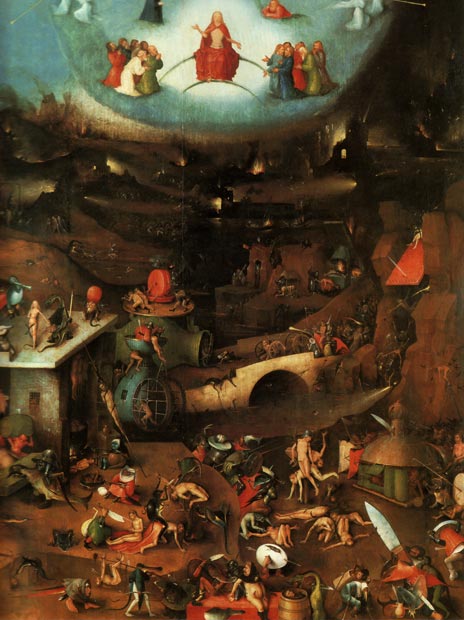
I'm enclosing this Hieronymous Bosch work, "The Last Judgment," for comparison in the way Druzcz also seems to have such a hierarchical structure in her works' makeup.

A feared underworld lurks below-- the skies opening to the heavens above.

In the image below, Druzsz' work is again quite Boschian in its makeup-- a feared underworld lurking beneath; a heavenlike dreamstate above.

The Dutch master was perhaps centuries before his time in many ways-- much like I believe Druzcz is as well.

Throughout art history there has been such separation in imagery-- the color fields, if you will, of Rothko-- where the horizon separates from the earth; above and below.

Yet Druzcz's imaginative piece seems to float in mid-air over the burial ground plots-- or more than likely trenches being dug for new plantings.

What's so interesting about this work, though, is how each and every piece has been painstaking crafted by Druzsz, then photographed in isolation.

Only upon her choosing its new location, (small conical structures she made in her studio, then photographing them, manipulating their light and texture), and thereby adding layer upon multiple layer of pristene lawns, winterized burlap fields and topiary plantings, does she showcase these elements of beauty and despair.

The evergreens seem to take on a new life, reaching new heights in her golden backgrounds.

The sepia tonalities of each image gives an almost antique quality to her work.

Here, we see the combination of roadside concrete drainage pipes juxtaposed with an endless horizon of bales of hay.

Much in the way of her previous topiary works, Druzsz again takes the route of multiple terracing.

Though Druzcz is referencing how man continues to exert control over nature, there is a stark dark element that is at play, but does not completely envelop the work.

When I first saw this work at right, I couldn't help but have my own preconceived notions of what the image stood for.

The tree wrapped in its "protective" blanket, if you will, sheltered from the elements, instead takes on a far sinister presence, looking quite similar to a Grand Wizard of the Ku Klux Klan.

This is not an image to be taken lightly.

Again, the star-scape backpainting gives it such a dream-like quality.

The cool-white light envelops us much in the way the blanket wraps itself around the nature.

As Druzcz mentioned in her talk, she is "Very comfortable with breaking those boundaries" of the everyday and commonplace and combine very unusual elements into something new.

With this exhibit she certainly has accomplished that, and much, much more.

For more information, go to http://www.likethespice.com/

The exhibit runs until October 7th.

Sunday, September 9, 2007

A peek into the split personality of Jim Torok at Pierogi 2000

Some days I find myself looking in the mirror and thinking, "Hot damn. God, I'm gorgeous. Just look at those lips. Lucious, full, plump; just the right tonality of pinks mixed with fleshy earthiness. Why, with those big green eyes and raven hair, I could pass for Ms. Jolie's sister, right? Right?????"

Rigggggght.

The very next day, the same mirror looms overhead, and I think, "My God. Look at you. Why do you even try? Your days are numbered. You're past it. There's no hope. Why go on? No one will ever see the things in you that you wish them to see."

It's that very duality of thinking-- the yin and yang, manic depression, or polar opposites that puts the drive into Jim Torok's "Recent Work" exhibit, which just opened in Williamsburg at Pierogi 2000.

I was immediately floored by Torok's honesty and extreme openness about the mental anguish that he deals with on a daily basis.

Success-- just what does it mean to us, as individuals, or as artists?

To each, it can take on a different meaning.

Does it mean hobnobbing with the Mary Boones or Jeffrey Deitches of the world, a vodka tonic with Tom Sachs, a Roberta Smith review, or does it mean having our friends beside us as we celebrate our work, and hopefully sell enough to maintain representation, and get just enough press coverage to maintain or pique interest.

In this case, with Torok, he has the devil on one shoulder, and angel on the next, and they're locked in a caged deathmatch like Ann Coulter and Maureen O'Dowd with no exit till blood has been spilled.

In Pierogi's front space lies the "negative" thinking mode of Torok.

All the self-doubt and frustration you could ever imagine is there for our examination in hilarious cartoon, or comic strip format.

Very pop, very now, very "cutesy," very in fact wrong.

Many days we all feel the same way about ourselves.

"What's the use?
Why go on?
Do we really matter?"

We see our efforts falling by the wayside in terms of making a real difference in the world.

There seems to be a daily barrage of "bad news," or factoids, snippets of how useless our little humanoid specs of matter are to the big picture.

With so many faces and bodies gathered at the front, I thought-- "Well, this is it. This is all there's to it."
Little did I know what lurked around the corner.

As such, I've seen this type of work before-- and many artists right now are bringing up the issue of "Just what is our value" in the greater scheme of things.

I'm thinking of William Powhida's great take on creating his "ArtStar" alter ego at his Schroeder Romero show last Spring.

But with all the focus on Pierogi's front room, it's actually the back room where Torok's true talent lies, exposing brilliantly executed small drawings and paintings of his subjects, including a stunning self-portrait (not shown here).

In many ways I felt a great kinsmanship with Torok's delectable sarcasm, wit, and failure to connect on a greater level that he highlighted with his "cartoon pieces."

But the fact of the matter is Torok is a genuinely gifted and talented artist.

The cartoon imagery does not reflect the steadiness of hand and eye and skill that true "art" has always represented throughout history.

Torok's hyper-realistic sketches and paintings (quite small pieces), are filled with such great detail, sense of color and luminescense, that I could barely believe that this indeed was the same artist.

And here is where the duality of this show can be negatively construed.

Does Torok's exposing of his inner doubt take away from his ability as an artist, or is it merely a self-expression needing to take root and blossom?
I'm unsure.

I find that the very layout of the exhibit at hand is what bothered me, because in this case, the doubt has triumphed the talent.

Self-confidence is a huge factor in the success of an artist, or any individual.

It truly does not matter how much nacent ability you possess, what school you went to, or how many names you can drop if you do not believe in your own abilities.

This is something that Torok must work on in the future if he is to continue to prevail.

This is not to say I certainly didn't enjoy these pieces of self-immolation to a huge degree, but there's a large portion of this exhibit that left me with unease.

In a sense, I'm absorbing the artist's exposed nakedness here, as are all the viewers.

What qualities in ourselves can we change so that we do not relegate our greatest works to the "back room" of our lives, or the galleries we contract to?

Some quite serious issues to consider when we put ourselves out there for judgment, or in this and other artists' cases, literally "for sale."

Torok has taken a big risk here, and I salute him for it.

BUT I do hope that he eventually conquers these doubts that are so in the forefront of his mind, and continues to do the work he is so skilled at-- bringing to life these images of acquantances and subjects.

I truly felt at any moment that these tiny people would leap off their paper or boards and start speaking to me.

With such an amazing ability to capture the human essence of his subjects' personalities as well as physical trailts, one can only hope that he continues on this path instead of navel gazing despair and self-deprecation.

The exhibit runs until October 8th.

For more information, go to http://www.pierogi2000.com/

Tuesday, September 4, 2007

Thomas Lendvai at Winkleman

Contruction Worker #1:
"Yo.
Ya hoid' about Tommy?"

Construction Worker #2
"Yeh. I hoid' about Tommy.
He's going places, I tell y'ez.
Pass me an Amstel. Gonna need one for this job."


Many will view Thomas Lendvai's new exhibition at Winkleman Gallery, "Between Pain and Boredom," as strict textbook minimalist art mixed with optical illusion, or merely inventive modern installation, but I beg to differ.

That would be woefully underselling the magnitude of what this exhibit says about our culture, our own hearts, and our own thought processes (or lack thereof) when relating to our surrounding support structures (both literally and figuratively).

Sure, Lendvai wears his influences on his sleeve, echoing such greats as Gordon Matta-Clark, Donald Judd, and the earlier work of Richard Serra, but that's just the tip of the iceberg for his exciting Fall 2007 Chelsea premiere.

You see, Lendvai is more than just your typical artist-- he is a worker at his core with an old world ethic to match.


Not driven by a need to create and self-promote like far too many of his contemporaries, Lendvai instead has had visions of lumber, table saws, and power drills pulsing through his veins since his birth.

A product of a family encsconsed in the construction industry, Lendvai has been raised from little on to understand its inner workings.

While most boys his age were still playing with their Transformers, Lendvai was sitting atop the eaves of homes in Eastern Long Island, assisting his father and learning to master his craft.

It is of no surprise, then, that with his studies and higher education, that he has developed into a "sculptor" of a different realm-- one that continually surrounds us, but yet doesn't come immediately to mind as your standard "art form."

With this exhibit, Lendvai combines "architect" with "construction worker."

For too long, one has reaped the benefits and accolades, while the other languishes in obscurity.

In the process of working full-time and pursuing his art career, Lendvai has mastered balancing a duality so few can pull off-- establishing a well-earned reputation as an art installation/crater and contractor, as well as continuing his own quest into breaking the boundaries, and perhaps the walls, of our perceptions of what is real and what is "constructed."

For many gallery-goers and collectors, with the advent of the Fall 2007 season upon us, the fresh-hewn seams of newly formed walls pass us by with barely a notice.

"Was that there before?," we ask with puzzled faces, as each gallery looks "different" with each launch of a new exhibit.

Though Lendvai holds a Master's degree from SVA, his true secondary education has come about in the trenches of the art world.

When you see the work in many of Chelsea's top contemporary galleries, though you may be viewing the artist's initial vision, you are more often than not the worksmanship of Lendvai himself.

I will not name names, but there are several artists who currently are getting major reviews who owe Lendvai a huge thanks for not only "assisting them" with their installations, but creating much of their works from their initial conception to completion.

But now it's time for his work to take front and center stage.

This is the exhibit of the Fall 2007 art season, and I make no qualms about my own cheerleading here, for the real reason I love this work so much is because there is so much heart and soul of the artist himself put forth into his creation.

Taking the skeletal framework of a "new room" created specifically for this exhibition at Winkleman, Lendvai has made it appear that the walls (or perhaps ceiling in this case) literally cave in on us.

Feeling as if you must duck to avoid total annihilation, wooden beams jut out at perfectly spaced 16-inch intervals, much as a pitchfork through a bale of hay.

Making it appear as if a battering ram has come through Winkleman's 27th Street headquarters, the teeth of each wooden beam violently pushes forth, arching out and over as it makes its way into the gallery's main space.

In many ways, it appears Southwestern in its appearance, not unlike the exposed beams that are common in the pueblos of the desert southwest.

http://images.jupiterimages.com/common/detail/93/16/22811693.jpg

http://www.fostertravel.com/nmarts102web.jpg

But references to a certain style of construction is just part of this exhibit.

Lendvai does not sketch his structures prior to their building, nor does he call Autocad a close friend.

Instead, he utilizes the same methods that his Hungarian father taught him from childhood.

He carefully analyzes the weight-baring capacity of each stud in the walls' framework utilizing plumb bobs, and makes adjustments accordingly to the exact location of where the beam will rest.

Each measurement must be completely precise to leave no space or portion exposed.

Much in the way that Gehry's buildings create waves of movement, so, too, does Lendvai's work-- with each raising and lowering of the beams crossing the viewer's path, a sense of motion is created.

Of course when standing amidst the work, your own perception is relative.

Whichever stature nature has blessed (or cursed) you with, you will view this exhibit differently than the next.

This is what makes the work so unique.

In many ways, art today is a given... "THIS is what the artist means here. Here's the DEFINITION of this piece."

I have to say that I feel fraudulent for even trying to interpret this work, but it's simply something that I feel I must do.

Lendvai, a great fan of Arthur Schopenhauer, is specifically referencing humanity's different states of being.

Are we currently in a mode of "boredom," (distraction, inactivity, rest, complacency, squirminess, 'meh) that eventually will swing the pendulum right back to "pain," (anger, frustration, misunderstanding, entrapment, cultural ennui, or loss) that is essentially the eternal calling card of the human condition.

A bit unsettling to think about, given the heavy beams overhead, (or under arm) but truly a nice play on philosophical thinking mixed with the reality only a solid mass such as this could bring.

The last thing I will touch upon for this exhibit is the anonymity of those in the field of construction.

For every author, painter, filmmaker, or actor, there is a name left for historical reference.

"Here lies XXX, writer of XXX..."

But those who toil in construction are anonymous authors, if you will; innovators whose greatest creation lies on the inside, forging a reality the mad creations of the Santiago Calatravas of the world, molding the hidden skeletons that support us every day.

From the 22nd Floor of our Manhattan skyscrapers, to the basement hidden below Winkleman's terminal warehouse trenches, to the third floor of the 100-year-old oak framed Victorian bedroom where I now type, we rarely acknowledge what actually goes into making our least thought about ally-- a "support system," that continually props us up while at rest, in thought, at play, in love, or in a moment's passion.

Who were these men and what were their stories?

We tend to forget when we look upon the Empire State Building, in this case, or the great Pyramids, and call them the "Wonders of the World," as if some magician came along, or greater being waved his hand and said, "Thy Will Be Done."

Perhaps with the mountains, land or the sea, but in the case of structures, it is all manmade.

In this case, no Allah, G_d or Jehova created this, just "Tomi from Ronkonkoma."

Great exhibit with possibilities of legendary historical proportions.

The exhibit runs until October 6th, and opens tonight, September 6th, from 6-8PM.

For more information, go to http://www.winkleman.com/